Fa-thor: A Viking-Inspired Font That Stitches With Character
As someone who’s stitched hundreds of custom apparel pieces—from baby onesies to boutique aprons—I opened Fa-thor expecting boldness. What I got was something more: a full-color font with unmistakable presence, grounded in craftsmanship and loaded with storytelling potential. It’s not just typography—it’s a design asset with attitude.
First Impressions: Blocky, Bold, and Unapologetically Thematic
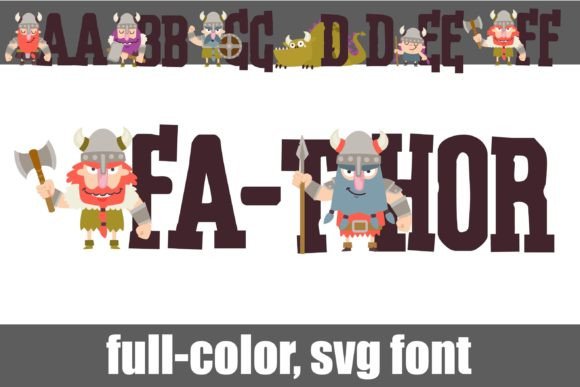
Fa-thor lands like a well-placed hammer strike: thick serifs, sharp angles, and that defining detail—the Viking figures embedded in the uppercase letters. They’re not decorative flourishes; they’re structural elements, carved into the letterforms like runes on stone. The blocky silhouette reads clearly even at medium sizes, and the color layering (yes, it’s a true color font) adds depth without clutter. This isn’t a font for subtle branding—it’s for projects where personality leads the way.
I immediately pictured it on a heavyweight cotton tote bag for a local Norse-themed craft fair stall. Not as a logo, but as the shop name stitched across the front—bold enough to catch eyes from three feet away, rich enough to feel handmade, not digital.
Where Fa-thor Shines in Real Embroidery Projects
Fa-thor thrives where visual impact matters more than minimalism. On a charcoal sweatshirt? Absolutely—it holds its ground against texture and weight. On a linen tea towel for a holiday market? Yes, especially when paired with simple fill-stitch backgrounds or minimalist running-stitch borders. As an embroidered patch for a denim jacket? Its strong outlines translate beautifully into satin-stitch edges, and the Viking motifs give instant narrative appeal.
For Etsy sellers offering personalized gifts, Fa-thor works best when the recipient leans into the theme—think baby embroidery on a wool-blend blanket (“VALI” or “BJORN” in soft heather gray thread), or a wedding gift pillow cover where the couple’s initials are rendered in Fa-thor’s alt version, with richer tonal variation accessible via character map. That alt set isn’t just extra colors—it’s flexibility. Swap from deep navy to burnished gold depending on fabric tone, and the font keeps its integrity.
Small business owners using it for boutique branding—say, a Scandinavian-inspired kitchenware line—will find Fa-thor elevates product tags and packaging mockups instantly. In printable mockups, it reads as premium, not playful. That perception carries through to the finished product.
Where to Proceed With Care
Fa-thor is expressive—but expression has limits in stitch. On thin or stretchy fabrics like jersey or lightweight rayon, those bold serifs can distort if stabilizer isn’t layered thoughtfully. I’d avoid it on baby onesies unless you’re using a tear-away + cut-away combo and testing stitch density rigorously. The fill areas in the Viking figures aren’t overly dense, but they *are* detailed—tiny shields, braided hairlines, axe handles. Those won’t resolve cleanly under 3 inches of hoop size or on highly textured burlap.
Curved surfaces—like caps or curved pillow seams—require careful digitizing adjustments. Fa-thor wasn’t built for distortion, so if you’re converting it to a machine embroidery design manually, expect to simplify some contours. And on dark fabric? Don’t assume contrast. Test thread colors first: a warm ochre might read better than true gold, and charcoal gray often outperforms black on black backgrounds for legibility.
Also worth noting: while the font supports personalization, its thematic strength means it won’t suit every brand voice. A modern skincare line? Probably not. A Viking reenactment group’s merch table? Absolutely.
How Fa-thor Shapes Perception—and Sales
In handmade product markets, perception is currency. Fa-thor signals intentionality. When customers see it on a custom-embroidered apron at a farmers’ market, they don’t think “font.” They think “crafted,” “distinctive,” “made for this.” That builds trust faster than generic sans-serifs ever could.
It also raises perceived value—not by being expensive, but by feeling *considered*. A holiday embroidery on a wool blend throw feels heirloom-ready when Fa-thor anchors the design. A personalized gift gains emotional weight because the lettering tells part of the story before the recipient even reads the name.
For digital product sellers, Fa-thor is a smart addition to a themed bundle—paired with Nordic motif applique designs or stitchable rune charts. But remember: as a color font, it behaves differently than standard embroidery files. You’ll need to confirm licensing before bundling it as part of a commercial embroidery file pack or selling derivative digital assets.
Practical Designer Notes Before You Stitch
- Always test on scrap fabric first—especially with the alt color set, since thread behavior changes with hue saturation and fiber type.
- Review stitch density in your embroidery software. If it’s high, consider reducing fill density slightly for breathability on apparel.
- Confirm hoop size compatibility. Fa-thor’s uppercase letters sit comfortably in a 4×4 hoop at ~2.5" height—but go larger for maximum clarity on totes or blankets.
- Inspect small details at actual stitch scale. Zoom in on the axe head in “A” or the knotwork in “R.” If it blurs or feathers, simplify manually before sending to machine.
- Test black-and-white mockups alongside color versions. Some clients prefer monochrome for versatility—know how Fa-thor reads without its color layers.
- Compare light and dark fabric backgrounds side-by-side. What pops on ivory may disappear on navy—adjust thread choices accordingly.
- Use appropriate stabilizer: medium-weight cut-away for knits, tear-away for stable wovens, and fusible + tear-away for delicate linens.
- Verify licensing terms before using Fa-thor in client work, commercial embroidery, or resale items—even if it’s bundled with other fonts or design assets.
Fa-thor doesn’t whisper. It announces. And when you pair that confidence with thoughtful execution—testing, adjusting, respecting fabric and stitch—it becomes more than a font. It becomes part of the story your handmade product tells before it’s even touched.