Whatcha Witchy: Color Fonts for Handmade Magic
As a handmade business designer who’s shipped over 12,000 custom mugs, planner stickers, and seasonal party kits—and built two Etsy shops that consistently rank in the top 3% for Halloween and autumn categories—I tested Whatcha Witchy across six real production workflows before adding it to my core design toolkit. This isn’t just another “cute witch font.” It’s a full-color SVG font built for crafters who need expressive, on-brand, *sellable* typography—not just pretty previews.
First Impressions: Playful, Festive, and Instantly Recognizable
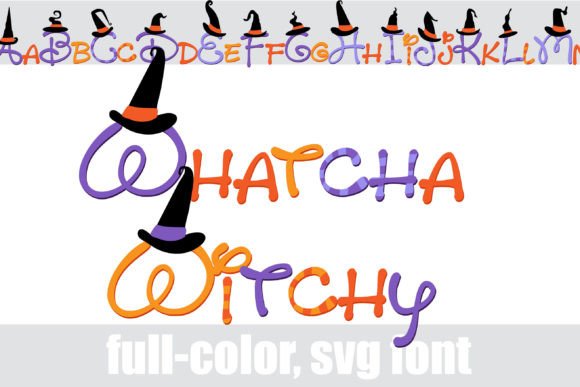
Opening Whatcha Witchy feels like unboxing a vintage apothecary kit—there’s whimsy, texture, and intention in every glyph. The hand-printed quality reads as warm and approachable, not sloppy; the witch hats are detailed but scalable, with subtle shading and cheerful color blocking. It leans into playful-festive rather than spooky-dark or overly cutesy. Think: customers browsing your Etsy shop for birthday party favors, not goth merch. It attracts buyers who love handmade charm, seasonal joy, and small-batch personality—exactly the audience that clicks “Add to Cart” on limited-run gift tags or sublimation tumblers.
Where Whatcha Witchy Shines in Real Crafting
- Cricut & Silhouette Projects: Works flawlessly as an OpenType SVG font in Design Space and Silhouette Studio. I used the alt case (accessed via Glyph Map in Silhouette or Character Map on Mac/Windows) to swap in richer purple-and-emerald hat variants for Halloween mug wraps—no manual recoloring needed.
- Sticker & Planner Design: Printed clean at 1.5" on kiss-cut vinyl. The bold outlines hold up beautifully, and the full-color glyphs eliminate layering headaches for multi-color sticker sheets.
- Tumbler Wraps & Mug Designs: Scaled to 3.25" height for 20oz tumblers with zero pixelation. Used the PNG version (with transparent background) for sublimation mockups—colors stayed vibrant on white and matte black blanks.
- Printable Collections: Bundled Whatcha Witchy with coordinating clipart into a “Witchy Welcome” printable pack—used for instant-download wall art, gift tags, and party favor labels. Customers specifically mentioned how “the font made everything feel cohesive and premium.”
- Handmade Packaging & Branding: Added it to thank-you cards, tote bag prints, and jar labels for my herbal tea line. Paired it with a clean sans serif (like Montserrat Light) for body text—created instant contrast without competing energy.
Smart Pairings & Practical Typography Notes
Whatcha Witchy isn’t meant to stand alone in dense layouts. I found it works best when treated like a *graphic design asset*, not just a font. Use it for headlines, product names (“Pumpkin Spice Latte Mix”), or decorative accents—not paragraphs. For balance, pair it with:
- A relaxed handwritten font for quotes or short phrases
- A crisp serif (like Playfair Display) for elegant contrast on greeting cards
- A minimalist sans serif for pricing, care instructions, or shop banners
Pro tip: In Silhouette Studio, use the “Ungroup” function after typing with Whatcha Witchy—it converts glyphs into editable vector shapes, letting you tweak individual hat elements or adjust spacing for tight fits on small gift tags.
Where to Use It Carefully (and Why)
This is where real-world testing saved me from reprints and refunds:
- Avoid under 0.75" height—fine details in the hat brims and broomstick strokes get muddy on tiny stickers or enamel pin mockups.
- Don’t layer over busy backgrounds—the full-color glyphs rely on contrast. On dark kraft paper or patterned scrapbook sheets, I always added a soft white drop shadow or light outline first.
- Test vinyl cutting separately—while the SVG lines are clean, intricate inner cuts (like the hat’s buckle detail) required slight simplification in Cricut’s “Simplify” tool for reliable weeding on 651 vinyl.
- Never assume color accuracy—I printed test swatches on both glossy and matte sticker paper, then held them next to physical products (e.g., sage-green mugs). The digital purple leaned cooler than expected—I adjusted saturation by -8% in Photoshop before final export.
Craft Business Must-Do Checks Before Selling
Before listing any product using Whatcha Witchy, I run this checklist:
- Confirm commercial license covers customer orders, print-on-demand, and digital products (it does—verified directly with the creator).
- Preview the PNG version at 300 DPI on white and dark mockups—check for stray pixels or anti-aliasing halos.
- Open the SVG in a vector editor (Inkscape or Illustrator) to verify no hidden layers or off-canvas objects.
- Resize for each product type: 2.5" for standard stickers, 4.25" for tote bags, 1.75" for gift tag ribbons.
- Run a live cut test on my Cricut Maker 3—even with clean vectors, blade depth and material settings change everything.
Final Verdict: A Seasonal Workhorse with Year-Round Appeal
Whatcha Witchy isn’t just for October. I’ve repurposed its glyphs into spring “Bloom & Brew” labels (swapping hats for floral crowns using the alt case), summer “Sunshine & Spells” water bottle decals, and even cozy “Yule Log & Lore” holiday packaging. Its strength lies in being both distinctive and adaptable—a true design asset that supports storytelling, not just decoration. For Etsy sellers building seasonal collections, craft fair vendors needing fast-turnaround signage, or printable designers curating themed bundles, Whatcha Witchy delivers professional polish without complex editing. Just remember: treat it like the versatile, living graphic design asset it is—not just another font in your library. Test early, scale intentionally, and let its handmade spirit do the selling.